Updated at 3:59 p.m. on Wednesday, Dec. 3, 2025.
Two engineers were rescued from the Gunnison River Tuesday night after a Union Pacific train derailed into the river.
Mesa County Sheriff’s Office spokesperson Molly Casey said the derailment occurred around 11 p.m.
“They were able to bring the engineers out of that derailed train car at about 1 a.m., and it was snowing heavily most of the time. So there was a fear of a bit of hypothermia, so we're glad we were able to get them out. Right now, that is what we have from the scene and we are working with our responding agencies to provide a more thorough response as we're able to kind of put together more information,” Casey said.
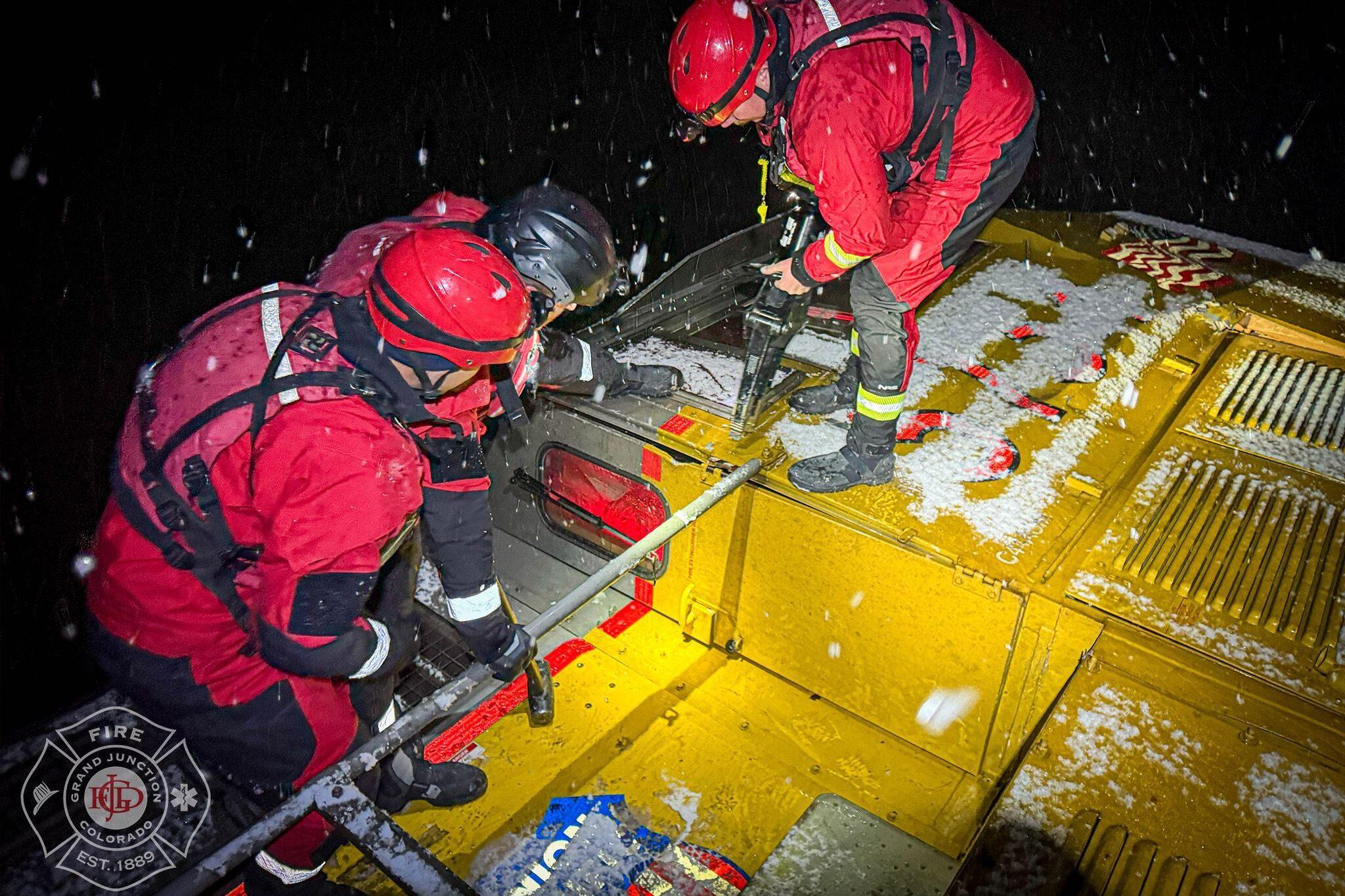
The engineers were uninjured. Deputies with the Mesa County Sheriff’s Office used a drone to locate the derailment, which occurred in a remote section of the river with difficult access points. Search and rescue personnel and paramedics with the Grand Junction Fire Department traveled to the stranded engineers via a road-rail vehicle from Union Pacific, according to a press release from the Grand Junction Fire Department.
The derailment was caused by a rockslide south of Whitewater, a Union Pacific spokesperson said in an email. Two locomotives and five traincars loaded with coal derailed. Some fuel has leaked and cleanup is underway, according to Union Pacific. According to the fire department, Suncor Energy, which has a location in Grand Junction, provided absorbent booms for the leaking diesel fuel.
The derailment occurred between the areas of Bridgeport and Whitewater, which is 10 miles south of Grand Junction. Train tracks run along the Gunnison River between Delta and Grand Junction.
Nicholas Ingalls, a volunteer with Mesa County Search and Rescue, was on the response team that helped pull the engineers from the locomotive. He said the response time moved quickly because the Mesa County team had some inside knowledge on their staff.
“We actually have a member that's a railroad engineer during the day and volunteers with (Mesa County Search and Rescue) at night,” Ingalls said. “He was absolutely critical in connecting up our understanding.”
Ingalls said this allowed them to connect with Union Pacific quickly and facilitate a specialty vehicle that can drive on train tracks — referred to as a “high roller” — in order to get to the rural part of the county where the train derailed.
“We were looking at access from the quarry across the river on (Highway) 141. That's been a traditional access point we've used for stuff along that stretch of river,” Ingalls said. “But unfortunately the road only goes for roughly a mile before you're then hiking on foot. So, it's not really an option to insert boats and swift water gear up that side of the river.”
Given the situation — a derailed train in a difficult-to-access stretch of river at night, during a snow storm — Ingalls said the rescue went quickly. They also knew exactly where to look when they had to pry the hinges off the damaged door to the locomotive with the help of the Grand Junction Fire Department.
“We had that BNSF employee that was able to give us a rundown of hazards that we should be aware of on the locomotive as well as give us exact points of where we should focus on getting (the engineers) out,” Ingalls recalled. “I'd never stepped foot onboard a locomotive before, so I think all of us were going in without any kind of past experience. Everything he described was exactly how it was.”
Because the locomotive was on its side, the crew had to fashion a makeshift ladder for the engineers to climb out. The operation wrapped up a little more than two hours after the report came in.